
Riverside Arts Center's "Insecurity: Not Enough Again" exhibit explores personal and social uncertainties

Insecurity takes many forms and shapes: visually, culturally, personally, and within communities. But what is insecurity and how can it be cultivated to produce change?
Riverside Arts Center’s Insecurity: Not Enough Again suggests it is often “a gnawing at the pit of the stomach,” a series of nagging, persistent questions: “Am I enough?” Or, “Will there be enough?”
The Ypsilanti gallery asked artists to consider what insecurity means to them while also partnering with local nonprofits and organizations to address food and housing insecurities in the Washtenaw area.
Riverside’s exhibits frequently pair with broader community organizations, and the Washtenaw County Community and Agency Fair will take place on January 25 from 12-4 pm at the Arts Center and is free to the public. Additionally, on Friday, January 18, Keena Winterzwill will appear at the galleries for a book release and signing, with performances by Jameelski of Breathe Easy Music Group, BMC, Dope Ther@py The Poet, and Joey Crues.
Straight Outta Nairobi: Dr. Pete Larson's Dagoretti Records brings the sounds of Kenya to Ann Arbor
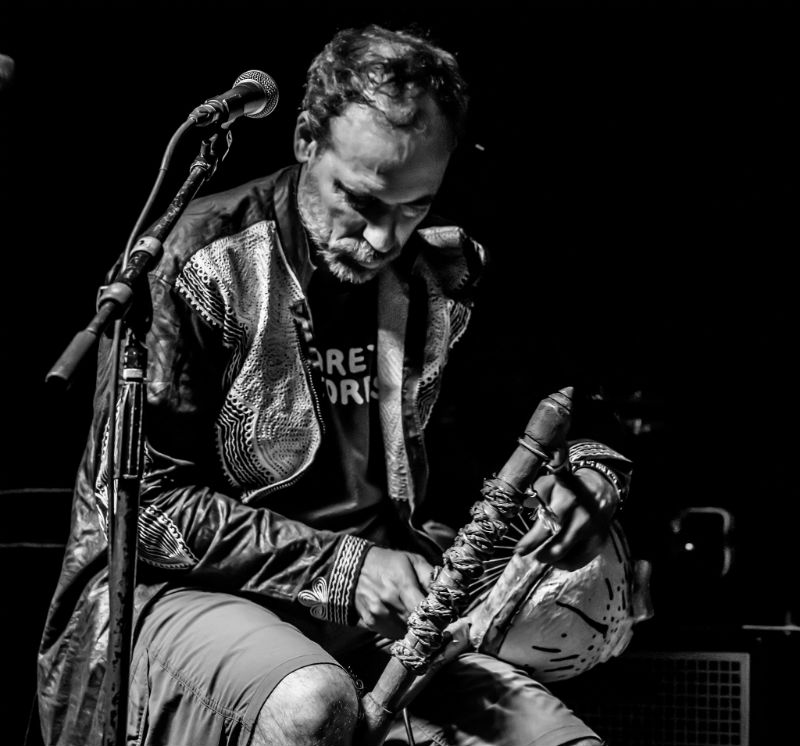
When Dr. Peter Larson found out he was going to Malawi in Southeast Africa as part of his graduate studies, one question came to his mind:
"Where's Malawi?" Larson said with a smile during an interview at the Ann Arbor District Library. "I didn't know anything about Africa."
Now an epidemiologist at the University of Michigan's Institute of Social Research, Larson later went to Nairobi, Kenya to work on public health issues. He lived there between 2014-2017 and immersed himself in the music scene.
That experience changed the trajectory of Larson's artistic life.
A longtime guitarist who played in numerous rock and noise bands since the 1990s, including 25 Suaves and Couch, Larson is also one of the people behind the experimental Bulb Records, which released the first records by Wolf Eyes and Ann Arbor native Andrew W.K.
But Larson was so enchanted the first time he heard a nyatiti -- an eight-string lyre/lute-type traditional instrument of the Luo people in Western Kenya -- he decided to learn how to play it.
"In 2015, I received an instrument from a friend and had no idea what to do with it," Larson wrote in the press release for the Nyatiti Attack LP on Dagoretti Records by his teacher, Oduor Nyagweno, who he lovingly calls Old Man. "Sometime in 2016, I saw Daniel Onyango play with his band Africa Jambo Beats in Nairobi and approached him about taking lessons. He then introduced me to the Old Man, I haven’t looked back."
Women of color in Washtenaw pen poetry anthology, "Love & Other Futures," as part of the Untold Stories of Liberation & Love project

A writing space created for and led by women of color in Washtenaw County.
That’s what the five organizers of the Untold Stories of Liberation & Love project sought to build and have been creating with the help of an Ann Arbor Area Community Foundation grant. They held three Ypsilanti-based workshops with local women of color and produced a poetry anthology, Love & Other Futures, by those women in 2019.
Planning is underway for this year, the second of two years of funding. Carrying out this vision has been a means to engage in community and leadership that is deliberately disruptive to writing here.
“We’re disrupting the idea that poetry is an elite thing," said poet and organizer Julie Quiroz. "We’re disrupting the way that our society turns art into a competitive, individualistic process, rather than a way to build community. We’re challenging our county to recognize the powerful creative leadership that already exists among women of color here."
Curiosity Cured the Cat: Dr. Howard Markel encourages readers to explore in "Literatim: Essays at the Intersections of Medicine and Culture"
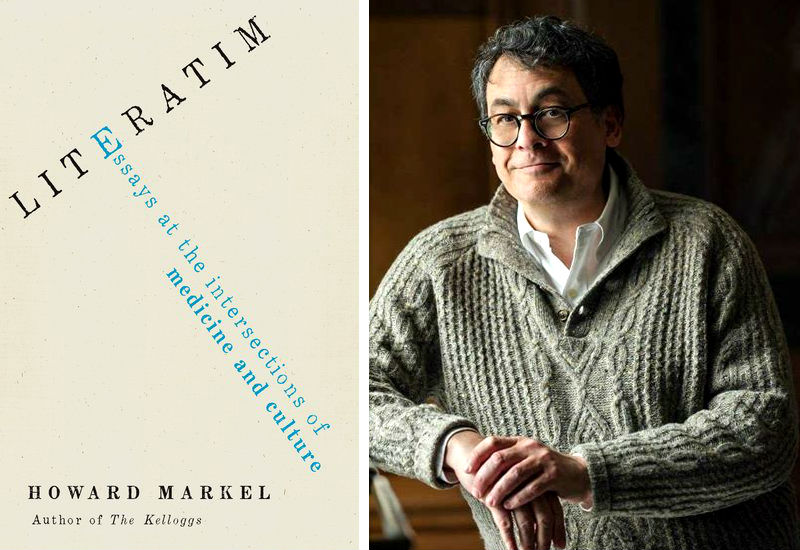
When you've been a medical journalist for decades and have written hundreds of essays and articles, it might be difficult to determine which writings to include in a collection. But Dr. Howard Markel says it wasn’t as hard as one might think to assemble Literatim: Essays at the Intersections of Medicine and Culture.
“I’ve written for a variety of places, but a lot of that has been reportage and not essays. Some articles about patients really didn’t fit either,” says Markel, who is the George E. Wantz Distinguished Professor of the History of Medicine and the director of the Center for the History of Medicine at the University of Michigan. “I wanted the book to be about medicine and how it intersects with culture, so after talking with the editor at Oxford University Press, I went and got my articles out of my file cabinet and literally put them on the floor in front of me. After I wrote the introduction, the rest came together nicely.”
Nothing IFFY about the newly announced Independent Film Festival Ypsilanti

Washtenaw County is renowned for its cinema events, from the predominant Ann Arbor Film Festival (March) and the Sundance/Cannes/etc.-affiliated Cinetopia (May) to the new Nevertheless (July), which focuses on female-identifying filmmakers, and all the traveling fests and U-M-sponsored foreign-film series.
But all of those events happen in Ann Arbor, primarily at the Michigan Theater.
Filmmaker Donald Harrison, who runs 7 Cylinders Studio, and multimedia artist Martin Thoburn want to make another part of Washtenaw Country an important destination for cinephiles, so they've launched the annual Independent Film Festival Ypsilanti (IFFY).
"I've imagined a film festival happening in Ypsilanti for almost a decade," Harrison said via email, "but venue options have been limited. Last year Martin expressed interest in starting it with me -- it was especially appealing that the festival's identity would be IFFY -- so we set things in motion."
Songs to Learn and Sing: Catching up with The Kelseys and KWITNY
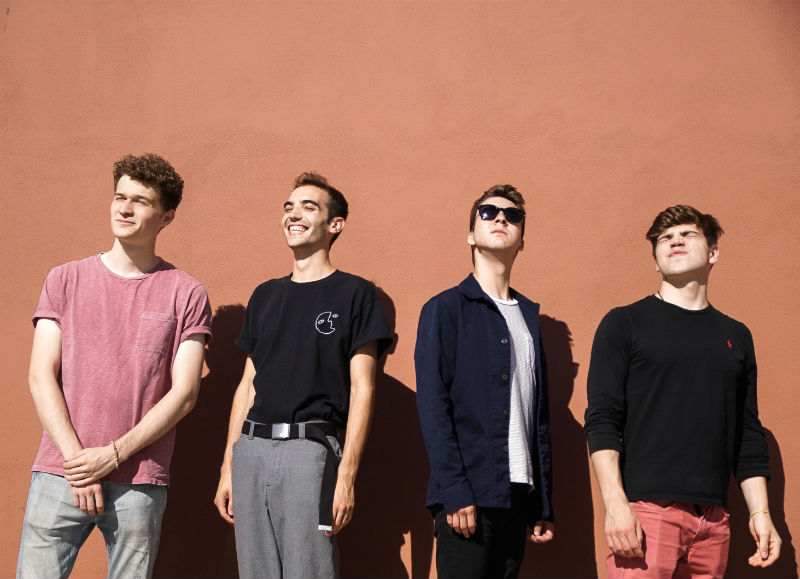
A lot of us hibernate in the winter -- and to an outsider, it may seem like The Kelseys have been slumbering since last spring. But the Ann Arbor pop-rock band, which has only played a relative handful of concerts over the past year, is comprised of four full-time University of Michigan students, three of whom are in their senior year.
It's no fun doing late-night load-outs at a nightclub when you know there's a mechanical engineering test in the morning.
But even if The Kelseys haven't been on stage as of late, the group did release a steady stream of songs in 2019, and singer-guitarist Peter Kwitny continued to create and release solo music, too.
The Kelseys, who formed in 2016 and named themselves after U-M's museum of archeology, recently completed their So Little to Say project with the release of "Something Else," the fifth song in the series. (A 2018 Kelseys tune was also remixed last year into slow-burn electronica: "Pollyanna (Jeff Basta Mix)")
"These tracks were recorded at multiple locations," said drummer Josh Cukier of So Little to Say, answering Kelseys questions for Kwitny, guitarist Evan Dennis, and bassist Liam O’Toole (who is a junior at U-M). "All live drums were recorded in Toledo, Ohio, at Steven Warstler's studio. Most of the lead vocals were recorded there as well. Most other components -- guitar, bass, synth, and percussion -- were recorded in The Stu, which was the name affectionately assigned to [my] bedroom at the house we lived in last year. A few remaining components were recorded in the Duderstadt Studios with Ryan Cox acting as the engineer; these include the saxophone, piano, spoken word, and group vocal parts in '1998' and 'Something Else.'"
The Kelseys have self-described as an "indie-dance pop band," though that doesn't give enough credit to the group's radio-friendly sound: It's easy to imagine So Little to Say's upbeat "This Life" or "Everything Is Beautiful" wedged between Fun. and Foster the People on Ann Arbor's 107.1-FM.
Former U-M professor Carmen Bugan's new poetry collection, "Lilies From America," relates nature and the human experience

Poet Carmen Bugan has gone through many transitions, from her tumultuous childhood in Romania to moving to the United States. Still, she writes, “The road to a better life has not yet been planned, / Everyone is waiting for an architect.” Both uncertainty and possibility hover in those lines, which appear in a recent poem called “New Life.” That poem is among a new selection in Lilies From America: New & Selected Poems 2004-2019.
Lilies From America starts with a poem of the same title and then covers Bugan’s three collections -- 2004’s Crossing the Carpathians, 2014’s The House of Straw, and 2016’s Releasing the Porcelain Birds -- plus new poems dating from 2016 to 2019. Calling these poems autobiographical would be an understatement; they comment on family, nature, time, love, and language (the last of which Bugan discusses in-depth on episode 18 of The RC Podcast, “Carmen Bugan ’96 and the Language of Freedom”). This new collection discloses a snapshot of the trajectory of Bugan’s life, going from early days to current sentiments, through the well-selected and illustrative poems.
Bugan’s poetry is inspired by her childhood containing the political imprisonment of her father and exile of her family, and then by her experiences in the U.S. Her writing musters perseverance and suggests ways to keep going despite change and parting and borders. Looking to nature as a parallel, the poems draw on the landscape and flora of the places significant to Bugan. In “Long Island Sound,” dated January 23, 2018, cycles of starting and ending relate to human experience, as the poet reflects:
To see again that which I knew and cherished:
The translucent lift of water and algae,
Clam shells and egg-like rosy stones,
Fluent ending in a new beginning.
Nature becomes a way of understanding what is happening to the people in the poems. The “Moon" is set on an autumn night in a room aglow with moonlight and offers this last stanza: “I felt not too far from being translated, / The same way sunlight was interpreted / By the moon face we could see.” These feelings of being seen and of also making one’s own observations permeate Bugan’s poetry, both explicitly in describing the political protests written on a typewriter in Romania by her parents, as well as in sharing transcriptions of her family’s surveillance tapes, and subtly through the surrounding environment.
Yet even as time gives way to transformations, moments emerge to hold dear, moments in which to linger. On a visit to aging parents, the poet expresses a wish to accurately capture the instant: “While the glasses empty slowly and we are grateful / That we still can have that one drink, together, / Standing in the sunshine, with the song of birds.” Identifying these memories as important, and observing them, stand alongside the history of political protest and anguish in these poems.
Bugan is based in Long Island, New York, and she was the 2018 Helen DeRoy Professor in Honors at the University of Michigan and the 2018 Dow Visiting Scholar at Saginaw Valley State University.
Bugan reads with David Cope, who is Bugan’s former teacher from Grand Rapids Community College prior to her transfer to the University of Michigan, at Literati Bookstore on January 16, 7 pm. Ahead of her visit, I interviewed her for Pulp.
North Coast Modular Collective and MEMCO release new music and mixes, team for seminar

With North Coast Modular Collective (NCMC) and Michigan Electronic Music Collective (MEMCO), crafting art and then guiding others on how to do it are at the core of these orgs' guiding principles.
On Saturday, Jan. 11, at AADL's downtown location, NCMC and the U-M-associated MEMCO are teaming up to help people learn how to create music, DJ, and produce accompanying visuals. No registration required; just show up. Topics will include:
~ Introduction to Live Coding by David Minnix and TheTimeRipper
~ Getting Started With DJing
~ Ableton Live Production Demystified by Bill Van Loo
~ Introduction to DAW Production With FL Studio by Akshay Chacko
~ DIY Getting Started
~ Getting Started With Live Visuals
MEMCO and NCMC members are always busy creating their own music and mixes, including two recent DJ sets from the former and two new albums by artists with the latter:
U-M grad Chris McCormick's novel "The Gimmicks" meditates on relationships, wrestling, and the Armenian Genocide through altering perspectives

While the cover may show a picture of two opponents in a wrestling hold, The Gimmicks by Chris McCormick is about far more than matches. The novel chronicles the stories of Ruben Petrosian, Avo Gregoryan, and Mina, how their lives intersect, and how they love and hurt each other multiple times.
Each character overlaps with the others in ways that are both fortuitous and disastrous. Ruben, small and jealous, first feels envious of Mina’s backgammon luck and then goes on to seek revenge for Turkey’s denial of the Armenian Genocide with the Armenian Secret Army for the Liberation of Armenia in the 1980s. Avo, large and kind, comes to live with his cousin’s cousin Ruben and his family in 1971, gets caught up in a ploy to be a part of Mina’s backgammon success, follows a request by Ruben to go to the United States, strikes off on his own as a wrestler, and finds himself misunderstood in several situations. Mina, lucky and earnest, garners success in playing backgammon, and while her luck holds in some ways, she experiences various losses throughout her life. Terry Krill, Avo’s wrestling manager, reluctantly begins to recall his past and piece together the others’ stories 10 years after the fact in 1989.
Their converging lives are told through chapters grounded in particular times and places and through the reflections of these people. During a reunion between Mina and Avo, she tells him, “Our lives aren’t metaphors, halved or broken or split. Our lives are our lives, whole if they feel complete, whole if they feel incomplete.” Her message generalizes the agonizing challenges that they encounter. Good intentions might not be enough or allow them to fulfill their desires.
Early in the novel, Mina muses in a journal: “That the world is round makes me hope that time is round, too, and that maybe I’ll loop to the start one day.” At that unexpected reunion with Avo later, “she felt the muscles in her face mirroring his, signaling a blue smile of her own, and she knew all at once about the roundness of time.” Such parallels and recurring ideas appear throughout the book -- similes and metaphors rewarding for the reader. Another is when Mina’s husband recalls the story of his first wife and mother: "He defended one to the other with all of his heart, so that he ended up without the trust of either.” Similarly soon after, Mina accuses Avo of being caught between two people, of being "someone who confused love for something you could only loan out to one person at a time." These threads bring the characters’ stories that sprawl across time and countries together with poignant and harsh realities.
McCormick, also the author of the earlier short story collection, Desert Boys, grew up in California and graduated from the University of Michigan with an MFA. He teaches at Minnesota State University, Mankato.
McCormick visits Ann Arbor to read at Literati Bookstore on Friday, January 10, at 7 pm. I interviewed him ahead of time.
Judy Banker traces the spirit behind her new country-folk-rock album, "Buffalo Motel"
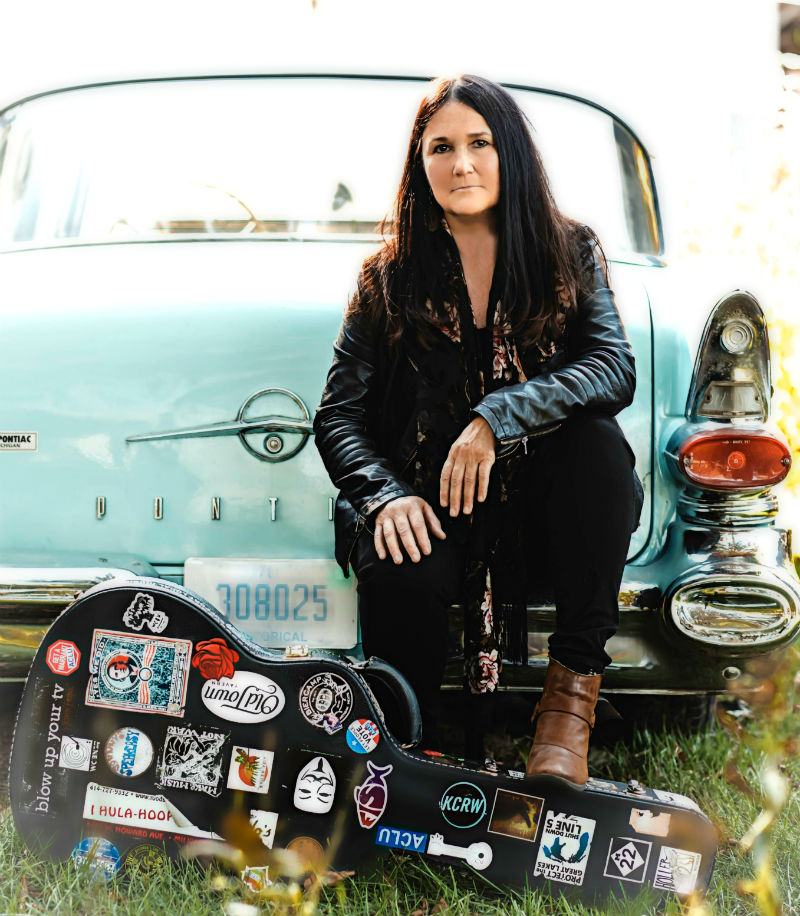
Judy Banker has been a mainstay of the local country and folk music scene for more than a decade when, along with her late husband, John Sayler, she began accompanying the well-known Michigan singer-songwriter Jay Stielstra on guitar and harmony vocals.
Banker continues to accompany Stielstra on stage, but after her husband passed away she also began recording and performing her own songs with a rotating lineup of musicians. Her new album, Buffalo Motel, is a significant departure from her previous two CDs.
While she again recorded at Dave Roof's Rooftop Recording Studio in Grand Blanc and worked with some of the same musicians who have been accompanying her in concert for years, Buffalo Motel, has a more “muscular” sound than her previous albums, to quote her co-producer and son, Ben Sayler. The instrumentation and musical arrangements of Buffalo Motel have a country-rock feel and are both more varied, full than her previous country folk-tinged recordings.
Banker celebrates the release of Buffalo Motel with a concert at The Ark on Thursday, January 9. I asked Banker about the new recording and her songwriting.
ARTS AROUND ANN ARBOR
DEFINITELY NOT HOMOGENIZED


